
“Gavigudet” Attended the Public Delibaration of the EIA Report of “Geo Enterprise” LLC
“Gavigudet” Attended the Public Delibaration of the EIA Report of “Geo Enterprise” LLC
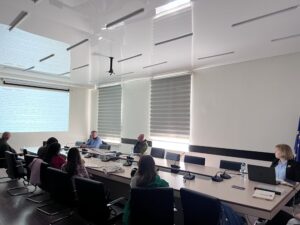 Today, on May 3, the civil movement “Gavigudet” attended the public deliberation of the Environmental Impact Assessment report of “Geo Enterprise” LLC; and after that we visited the production area.
“Geo Enterprise” LLC Plans to smelt iron scrap (steel and cast iron) and manufacture various castings.
The plant will operate 250 days a year, 5 days a week for 8-hour working schedule. The hourly throughput of the plant is 1 ton/hour. 25 people will be employed during the operation stage.
Both, from the report and from the inspection of the territory, it is clear that the establishment of the enterprise on the given spot is already completed, has stocked raw materials – scrap, which, on the one hand, makes the EIA report meaningless, and on the other hand, violates the Environmental Assessment Code. The EIA report should consider the impact not only during the exploitation process, but also during the establishment process. The given case does not provide the impact assessment for all stages. Besides, such practice increases the likelihood of bias to issue the positive environmental decision. The mentioned note, together with other comments and recommendations was prepared within the framework working group and was sent to the Ministry in written form.
We are sharing our comments, made on the public deliberation:
– The justification of the need presented in the EIA document does not actually represent the justification of the need. Given chapter does not provide the clear picture, as it only consists of superficial assessments. Moreover, we could easily say, that this chapter represents an artistic part and has nothing to do with evidence-based facts, that should support the decision-making process. Information, provided for the justification of the need, is subjective and superficial and is not based on data or traceable studies. Market research is mentioned, but we do not get any additional details, such as the period, when the research was carried out, or the results of the research. Consequently, it is impossible to justify the activity, based on the information provided on the EIA report.
– According to the Environmental Assessment Code, the EIA report should include the justification of benefits, based on the cost-benefit analysis. The submitted EIA report does not include this information, and only subjective evaluations are used to prove the necessity of the plant.
– The document does not provide the information about the scrap suppliance sources, and what share of it will be imported, as it is mentioned, that during the operation process the plant will use imported raw materials as well. Besides, there is no information about who will supply the enterprise with the raw materials, needed for the production, whether is it scrap, bentonite or quartz sand.
– From June 1, 2021 the continuous self-monitoring system is obligatory for each entity, subjected to the environmental decision, that carries out the activity defined by the annex of Georgian law on “Atmospheric Air Protection”. Activities, listed in the annex, include steel or ferroalloy production, including the primary or secondary smelting. This is exactly the type of activity, “Geo Enterprise” intends to carry out – production of steel and cast-iron castings. Therefore, the enterprise is obliged to install self-monitoring system in order to continuously control the actual amount of hazardous substances, emitted from the stationary sources of pollution. However, in the ambient air monitoring chapter(11.1) of the EIA report of the planned activity, we find the following record – “as you can see in the table 11.2, during the exploitation of induction furnaces, according to valid normative acts and project parameters, the concentration of the pollutant substances, emitted form the enterprise is small and, hence, is not a subject of continuous instrumental monitoring.” But, together with this statement, they do not indicate the specific normative act or acts, that frees the activity from the obligation of continuous self-monitoring.
– The EIA report includes the analysis of the alternatives, including the zero alternative. In this analysis we find the following argumentation – “if we consider the non-functioning of the existing building as a zero alternative, in few years we will face the same situation around the territory, as it is now.” – The activity implementer presumes the inevitable destruction of the building and manipulates with this fact; whereas it is quite possible to use the building for the type of enterprise in the future, which will not pollute the environment even during the operation phase. Moreover, the notes, made in the conclusion, are ambiguous and subjective and does not represent the solid proof to support the inevitable necessity to establish the enterprise – “During the exploitation process the requirements of the environmental legislation will be ensured, the impact on the environment will be slight, while social and economic benefits are going to be significant.”
– The discussion of the alternatives, given in the EIA report, does not actually represent the analysis of the alternatives; As 3 alternatives out 4, described in the report, are located in the same area, a few meters away from each other, and the 4th one is located in Tbilisi, around the densely populated area, thus simply excludes itself. Assessing the other three, loses the point of the environmental part of the alternative discussions; as the same area would be impacted, no matter which out of these 3 alternatives would be chosen.
– The EIA report should include the justification of the technology, chosen for the production process. This part is complete in regard with furnace, but eligibility criteria for the Russian-production filter and its superiority over other types of filters is not clear.
– According to the scoping decision, the company is requested to provide the mitigation measures, developed for the setting up and exploitation processes. But the EIA report only evaluates the exploitation process, as the enterprise set up was already finished by the time EIA process was conducted. This fact is the violation of the law.
– In the part of the document, where the mitigation measures for the impact on the atmospheric air are described, we meet the following note – “The proper action plan will be developed to prevent the atmospheric air pollution during the unfavorable meteorological conditions” – this part needs to delve into more details, namely: what does unfavorable meteorological conditions mean? Who and based on which parameters defines the unfavorable meteorological conditions? Which specific measures will be carried out within the action plan, and who will be the person in charge during the implementation of this action plan?
The informational material is prepared within the framework of the project – “Defending Our Right to Clean Air in Rustavi”, which is implemented with the support of the European Endowment for Democracy.