
“Gavigudet” Attended The Public Deliberation Of The Environmental Impact Assessment Report (EIA) Of The Cement Enterprise – “Standard Cement” LLC
“Gavigudet” Attended The Public Deliberation Of The Environmental Impact Assessment Report (EIA) Of The Cement Enterprise – “Standard Cement” LLC
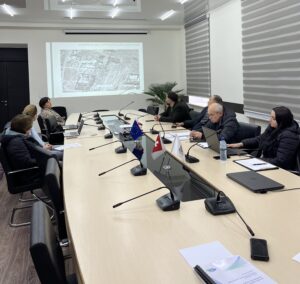 Today, on December 13, the civil movement “Gavigudet” attended the public deliberation of the Environmental Impact Assessment Report (EIAR) of the cement enterprise – “Standard Cement” LLC held at Rustavi City Hall.
The meeting was also attended by representatives of the aforementioned enterprise, the National Environmental Agency (NEA) and Rustavi City Hall.
As always, our team informed the public in advance about the public deliberation of the environmental impact assessment report (see the post).
The company produces both fine masonry blocks and cement. Cement is produced by grinding gypsum and additives, for which the company uses two units of Chinese-manufactured mills.
The enterprise produces three grades of cement – 300, 400, and 500 – corresponding to European standards.
The presented EIA report refers to the change in the operating conditions of the cement plant, in particular, it is planned to set up a new cement mill, expand the raw material warehouse and install additional 4 units of 120 m3 capacity cement silos.
According to the project, two existing mills with a total capacity of 84,000 t/year will be shut down and replaced by one new mill with a capacity of 160,000 t/year.
Our team discussed the EIA report in a meeting conducted within the framework of a working group in order to provide notes and comments. These comments were shared during the meeting and then submitted to the National Environment Agency.
During the public deliberation, we also clarified the issue of establishing a self-monitoring system. As the representatives of the company noted, the system was ordered from a German manufacturer, is now being transported, and will be delivered to the company no later than December 18.
In addition, we discussed that the determination of emissions by the reporting method cannot adequately represent the reality in enterprises in terms of emissions. Therefore, it would be inaccurate to calculate the cumulative impact using the information provided by the Ministry (we refer to the emissions of neighboring enterprises).
Read our comments below:
– In the chapter on alternatives of the EIA report, the technological alternative of both the machine and the cleaning filters and the advantages of the selected one are not discussed;
– In the given chapter, the company notes that according to the 2019 decision, the operating device is not safe for the environment. Its replacement was on the agenda only with the motive of increasing performance. In addition, it is noteworthy that one of the outdated devices is still being used as a backup, which can be considered a risk factor for adverse environmental effects;
– According to the EIA report’s chapter on zero alternative, “the establishment of the enterprise will make a small but positive contribution to the city in terms of improving the economic potential of Rustavi and the country overall, which is demonstrated in a certain increase of local and central budget revenues.” It is crucial to be clear about the specific economic advantages being discussed and the extent to which they outweigh any environmental damage that may result from the enterprise’s operations;
– In the chapter on alternative options for the location of the enterprise of the EIA report, it is mentioned that, in addition to the existing territory, the placement location of the equipment was also considered on a plot of land with cadastral reference code 02.05.03.783, which, according to the document, is state property and is 240 meters away from the population. As a result of the electronic verification of the mentioned code, it was revealed that the given plot is the property of “Asset Management and Development Company” LLC and is about 690 meters away from the nearest settlement. Hence, this issue is subject to clarification.
The selected and alternative locations are both in the same area, separated by just approximately 190 meters, which does not change much from an environmental perspective, except that the alternative area is, according to the available information, more remote from the population. It would be appropriate if the company proposed a realistic location in the document, the rejection of which would be supported by environmental considerations rather than infrastructure availability;
– According to the EIA report, one of the old cement production lines will remain on the territory of the enterprise and it will be utilized as a backup in case the new mill malfunctions. What is the guarantee, that both of them won’t operate simultaneously on a regular basis, given the fact that these two lines will exist separately?
– What are the technical and operational features of the old filter on the cement plant?
– According to the EIA report, additional equipment, except for the cement mill, used in the technical process was purchased by special order, thus their passport data is unknown. The aforementioned issue must be clarified since the characteristics of the products made by special order should be known to the company;
– According to the presented documentation, it is clear that the company uses slag as one of its raw materials, which is mostly located on the slag heap of “Rustavi Steel” LLC. The document mentions that the enterprise performs tests on the received raw materials in its own laboratory. Is the received slag analyzed and do these studies serve the purpose of determining its hazards? Are the results of laboratory analyses stored in the enterprise?
According to the EIA report, the products are stored in a shed-type facility. What is meant by a shed-type facility, and to what extent the products placed there are protected from the wind in order to prevent the formation of dust; A similar question can be asked about covered warehouses of raw materials;
– Page 30 of the EIA report says, that in order to reduce the impact on the ambient air, the following mitigating measures should be implemented, however, the list of planned measures is not given;
– The issue of waste placement and separation is vague in the EIA report and is viewed as a future activity, despite the fact that the company has already agreed on a waste management strategy. Therefore, it is necessary to clarify the details on the waste disposal area. Additionally, it is recommended to list the waste disposal area as one of the infrastructural facilities on the enterprise’s general plan. Such an unclear record complicates the inspection of enterprises by the Department of Environmental Supervision in the future;
– According to the EIA report, the company plans to green the area. What kind of plants will be planted, in what quantity and when?
– Noise and emission sources are not included in the general plan given in the EIA report;
-In the report of hazardous substances released into the ambient air, for some emission sources (such as, for example, raw material warehouses), the emission is calculated from the laying process. If such places are just covered and not hermetically sealed, there is a possibility of huge volumes of dust particles spreading in the case of wind, which should be included in mitigation measures.
– In the chapter regarding the noise mitigation measures of the given documentation, it is written that the enterprise should carry out its work during day hours, whereas the enterprise should work for 20 hours throughout the day. Accordingly, the mentioned issue needs further clarification;
– In Chapter 6.3.29 of the EIA report (Report on the Dispersion of Hazardous Chemicals in Atmospheric Air), there is a list of nearby enterprises whose emissions are counted as a background in computer modeling of the dispersion of harmful substances in the atmosphere in terms of dust distribution. However, chapter 6.11 (cumulative impact) of the same report, states that, as determined during the audit process, there are no stationary sources of dust dispersion in the enterprises within the 500 m normed zones close to “Standard Cement” LLC. The information given in the EIA report is contradictory and requires further clarification; Furthermore, “Nika 2004” LLC is not identified as a background source in the non-technical summary, despite the mentioned company being regarded as a background source in the EIA document. Because a large portion of the public is familiar with the non-technical overview, all of the documentation presented with the project must be complementary.
– In the noise propagation section of the cumulative impact chapter, only the noise caused by the operation of the equipment within the boundaries of the enterprise is discussed, despite the fact that the equipment is located in the production area and other objects are bordered within a radius of 500 meters.
– Only the GPS coordinates of the control stations of dangerous substances emitted into the air are included in the environmental monitoring plan. It would be preferable if the plan included the GPS coordinates of the noise propagation control locations.
– The frequency of the replacement of the filters needs to be specified;
-Even though, the decision has not yet been issued for the company, the earthworks necessary for setting up the enterprise have already been started, which, again indicates that the companies do not consider the case that they aren’t given the permit. Additionally, it also demonstrates the fact that the agency does not have the appropriate leverage towards such companies that prepare for activities and/or start activities without making the appropriate decision; It is desirable, that the agency should start taking care to amend the Environmental Assessment Code in order to regulate and prevent such unjustified actions by entrepreneurs;
– Lately, existing enterprises in the Rustavi area are actively increasing production, which considerably impacts the current environmental conditions. In a city, as busy with industries, as Rustavi, would the relevant agency consider imposing a city load norm to reduce the effects on both human and environmental health?
In the event of a concern, it is recommended that the letters we send to the Ministry be forwarded to the company as well, so that the same action is not repeated in the previous document during subsequent administrative processes. If the documentation is faulty or incomplete and our notes are included in the letter, it is desirable, we also receive the letter electronically at: gavigudet@gmail.com, or be notified. In case of discarding the notes, it is preferable to provide us with an explanation.
– Given that the civil movement “Gavigudet” actively monitors ongoing administrative proceedings in the Ministry about existing/planned enterprises in Rustavi, attends public discussions, and sends comments, it is preferable that the relevant decision or conclusion issued on a specific activity be sent to us, along with the company and the municipality.