
“Gavigudet” Attended the Public deliberation of the Scoping Report of LLC „Gia-2019″
“Gavigudet” Attended the Public deliberation of the Scoping Report of LLC „Gia-2019″
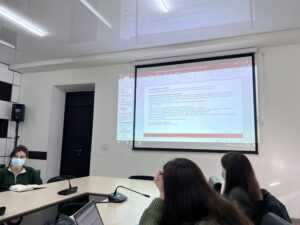 On March 17, the civil movement “Gavigudet” attended the public hearing of the scoping report of the cement enterprise LLC „Gia-2019“. The enterprise plans to install a separation mill with a capacity of 15 t/h, which will operate 24 hours a day, for 340 days a year and will produce an additional 122,400 tons of cement. Representatives of the Ministry of Environmental Protection and Agriculture, as well as the Rustavi Municipality and the company attended the public hearing.
As it became known during the deliberation, the enterprise is currently operating, although it does not fulfill its obligation regarding the continuous determination of the actual number of emissions from stationary sources of pollution into the ambient air by the instrumental method. Representatives of the company have not yet started the process of purchasing the self-monitoring system, therefore, it is likely that the enterprise will operate in violation of the new legislation in the coming months.
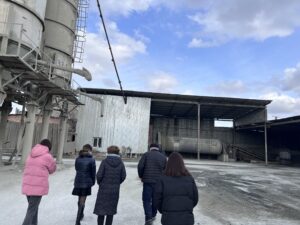 Following the public deliberation of the scoping report, our team visited the project territory on site.
On March 10, a working group meeting was organized by our team to discuss the scoping report. Through the efforts of the invited specialist, our team and volunteers, the remarks and recommendations have been prepared, which will be sent in writing to the Ministry, and we do hereby share them with you without changes:
– According to the scoping document, the distance from the project zone to the nearest surface water body (riv. Mtkvari) is 2,000 meters. Herewith, the document states that the distance from the enterprise to the “Mari” canal is 100 meters. Although the company does not provide for water abstraction and lowering, in the EIA report this canal shall be considered as the surface water body. In Addition, the distance should be specified, as the electronic verification revealed that the Mari canal is about 70m away from the cadastral borders of the project territory;
– According to the document, the nearest resident is 100 meters away from the cadastral border of the enterprise. As a result of electronic verification, the nearest common property 81.14.02.460 is about 90 meters away. This issue needs to be clarified, as each meter is important in the calculation of emissions and noise from facilities located in the production zones, especially when the settlement is located within a radius of 100 meters;
– In the chapter of the project territory location, there are not provided the list of all those facilities and specifics, that are within the radius of 500 meters of the enterprise area;
– If the company, in regard to the relevant measurements, provides the distances measured directly from the emission sources, then GPS coordinates of the emission sources present in the project territory should be given in the documentation so that interested parties can also verify the distances;
– It is unclear in the scoping documentation whether the existing enterprise is already functioning in accordance with the issued decision, or its operation is suspended, because the text of the document is written in the past, as well as in the present and future tense;
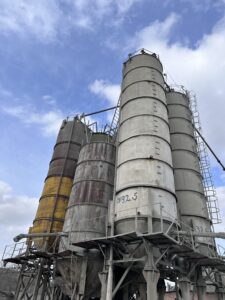
– According to the scoping documentation, “8 storage tanks located on the territory of the enterprise, which will be connected to each other, and cement will be poured in them in 3 alternating modes, will be equipped with a common/shared sleeve filter with 99.9% dust cleaning efficiency. Also, 3 units of separate storage tanks are planned, which will be connected to each other, and the cement will be poured in them in alternating mode, and they will be equipped with the common sleeve filter with 99.9% dust cleaning efficiency.” As it is clear from the report, at this stage 6 storage tanks are placed in the enterprise, and it is planned to add 5 more storage tanks. In the EIA report it should be specified the storage tanks with which data will be attached to the common system. In addition, as a result of the work of both machines, it should be specified, how many storage tanks will be filled at the same time and whether there are any technological limitations in terms of filling the storage tanks at the same time;
– It should be noted that none of the alternatives presents a proper justification and each of them serves only to give a preferred representation to the selected option. It is not clear whether, before the decision to increase productivity was made, the relevant forecast calculations were carried out for emissions into the ambient air, which revealed whether or not there would be an exceedance of the established norm. Discussing alternatives with the given methods does not provide any information in the documentation.
 – The issues of installing and operating a continuous instrumental self-monitoring system in the enterprise are not discussed in the scoping report and need to be clarified;
– Noise emission assessment is general because it does not specify which installations in the plant are noise-generating and what the noise level is at the point taken for calculation. It should also be noted that the enterprise plans to work 24 hours a day, therefore proper attention should be paid in this direction; Herewith, the documentation states that the installation of the device in a closed building significantly reduces the noise, although the photos presented in the document show that the building is not in proper condition and has some open spaces;
– According to the presented documentation, the drainage water generated in the project area will flow into the Rustavi drainage system, however, it is not clear from the scoping report whether there is a drainage system or a drainage channel directly on the project area, which provides transportation of the generated water.
– The waste management plan to be submitted in the EIA report shall specify the companies that will manage the specific waste during the operation of the enterprise, and the conditions for the expected disposal of waste in the enterprise should be given in detail.
– The cumulative information presented in the document is general and states that this issue will be explored at the EIA stage. While assessing this type of impact, not only the enterprise LLC „Heidelbergcement Georgia“ should be taken into account, but also the enterprise LLC „Mega Cement“ on figure 3.1.2. presented in the report;
– It is clear from the scoping documentation that the enterprise will operate 340 days a year. Because it is often not possible to control how conscientiously companies comply with this regime (especially when production takes place for 24 hours), the documentation should consider for what purpose the remaining 25 days will be used. In particular, for repair works, holidays, or the operation of the enterprise will be suspended;
– The document does not provide information on where it comes from or who is the supplier of raw materials to the company;
– The document does not provide information on measures to clear truck tires from dust before leaving the production territory, as well as the information on roofing and restricting the operation of the enterprise in unfavorable meteorological conditions;
– No information is provided regarding the irrigation of the project area and access roads in hot and dry weather;
– Given that the enterprise already has an environmental decision and is likely to be operational, it is necessary to check whether the company has complied with the conditions of the environmental decision issued by the Ministry (e.g. condition N8) and only then the new decision should be issued. There is a need for this, because in relation to the projects of Rustavi, there are frequent cases, when documentary (EIA and permissible emission limit reports) everything is fine regarding the emissions, but the reality is different. The existing enterprises intensively violate the correct operating conditions, do not use proper filters and consequently the air in the city is constantly polluted. Given that the Ministry today trusts the data reflected in the reports submitted by the company, it would be good to send an appropriate competence team to Rustavi to check the emissions of existing, functional enterprises (which change the operating conditions), which with its own tools and technical equipment measures and verifies harmful substances emitted from the plant into the ambient air. This will not only verify the information provided by the companies, but also to some extent it will be possible to create an appropriate database, which will reflect the relevant data on large and relatively small polluters in the city.
– If there are any remarks, it is advisable the letters sent by us to the Ministry to be sent to the company as well, so as for the future proceedings not to duplicate the fault mentioned in the previous document in relation to the same activity. In case the documentation is defective, and our remarks are included in the letter, it is advisable to send us the letter of defect or let us inform upon this fact. Even if the remarks are not considered, it is better to still let us know the reason for this.
– Due to the fact that the civil movement “Gavigudet” actively monitors the ongoing administrative proceedings in the Ministry regarding the existing/planned enterprises in Rustavi, attends public hearings and sends comments, it is desirable that the relevant decision or conclusion issued on a specific activity together with the company and the municipality to be also sent to us.
The information material was prepared within the framework of the project “Defending Our Right to Clean Air in Rustavi” which is implemented with the support of the European Endowment for Democracy.