
What Are the Changes in the Law of “Atmospheric Air Protection”?
What Are the Changes in the Law of “Atmospheric Air Protection”?
 On December 22, 2021, the draft law “On Amendments to the Code of Environmental Assessment” was submitted to the Parliament of Georgia, which aims to bring “the Law of Georgia on Protection of Atmospheric Air” in line with the the “Law of Georgia on Amendments to the Code of Environmental Assessment”.
According to the amendments, the National Environment Agency will be designated as the authorized body in the field of environmental impact assessment instead of the Ministry of Environmental Protection and Agriculture, and therefore this agency should carry out the activities, that were within the prerogative of the Ministry. In particular, obtaining information on stationary sources of ambient air pollution; consenting the draft norms of maximum allowable emissions of harmful substances and inventory technical report of the emitted harmful substances from stationary sources, state accounting of emissions; consenting the actual rates of annual emissions of harmful substances from stationary sources of pollution.
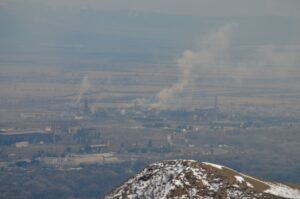
The law provides the possibility of expedite review of the stationary sources of air pollution and the technical report of the inventory of harmful substances, emitted by them. Also, the obligation to re-agree the inventory report without making changes to the stationary facility, only due to the expiration of the five-year period, was abolished. The Parliamentary Committee on Legal Affairs also sees a threat in the abolition of this obligation. In the note paper we can read: “It is advisable to discuss this issue further to avoid potential threats that may arise from the periodic failure to carry out such inventory.” For our movement, the weakening of the control mechanism is primary presumable threat. In case of Rustavi, as a rule, enterprises have everything in order only on papers and the Department of Environmental Supervision does not properly monitor the industrial zone, we think this change will further reduce the already lowered sense of accountability of enterprises.
The Ministry of Environmental Protection and Agriculture of Georgia responded to the Parliamentary Committee on Legal Affairs that every year, 30-40% (700-800 technical agreements) of the reports submitted to the Ministry are the inventory reports. The re-submitted five-year period report is identical to the previous, expired one and does not contain updated and/or necessary information for the Ministry. In addition, the note emphasizes that paragraph 5 of Article 30 of the Law on Protection of Atmospheric Air is not abolished. According to which, “in case of change of the location and/or profile of the stationary source of pollution, increased amount of consumed fuel and change of the listed parameter in other way, the agreed draft of the maximum allowable emission norms and the technical report of the inventory of harmful substances emitted from the stationary sources of pollution will be considered canceled. Redesigning and re-agreeing of the new conditions will be required.”
Moreover, as a result of the changes, the Agency is authorized to amend the environmental decision or the relevant administrative-legal act issued in the field of EIA in a simple administrative manner, if this individual-legal act defines the obligation of further study of certain elements/components of the environment. Therefore, according to study results, the Agency will determine the necessity of the changing conditions.
For additional information, the environmental decision-making process includes three stages: screening, scoping and EIA, within which the decision is made through public administrative proceedings, which ensures the effective involvement of the public in these processes. As a result of the planned changes, the decision at all three stages will be made in a simple administrative manner, which, as can be seen from the note of the “Georgian Young Lawyers Association”, attached to the draft law, is inconsistent with Part 2 of Article 63 of the General Administrative Code of Georgia, according to which, administrative legal act can only be amended with the same manner it was originally issued. Which means that an amendment to an act issued through a public administrative proceeding can only be made through a public administrative proceeding.
“Gavigudet” agrees with “GYLA” remark that, unlike public administrative proceedings, simple administrative proceedings do not allow interested parties to receive timely information about planned changes and submit their views and comments on the matter.
It should be noted, that along with reducing the role of public involvement, the law was considered by the Parliament in an expedited manner. The date of discussion for the first hearing in the plenary session is February 1-4, for the second hearing – March 16-18 and for the third hearing – March 17-18. At such times, it is especially important to provide information about the process to environmental organizations operating in the country, in order to be aware of any significant changes in advance and to make recommendations on them. Cooperation and feedback should be equally important and valuable for both parties, as exclusion of the non-governmental sector from the process, at least indicates communication gaps and gives the impression that improving legislative framework in regard of environmental issues is not the actual will of the legislative body. This suspicion is reinforced by the fact that, despite public involvement and demand, the amendments to the Law of Georgia on Atmospheric Air Protection (which stipulates the obligation of enterprises to have a self-monitoring system) were approved only on March 2, 2021, when the amendments were initiated in August 2020. Until then, we were promised that these changes would have already been approved at the 2020 spring session. In order to avoid similar incidents in the future, we think it is necessary from the legislative body to find a more effective way of communication, which will allow environmental organizations, especially for those, working air quality improvement, to be more actively involved in the process, resulting in an improved legislative framework, that depicts the best interest of both, the environment and the population.
We would like to inform you, that entering into force of the mentioned bill is expected from the May 1, 2022, except for the paragraph of expedite review of the stationary sources of air pollution and the technical report of the inventory of harmful substances, emitted by them. This later part is expected to enter into the force from the year 2023.
The article was prepared in the framework of the project “Defending Our Right to Clean Air in Rustavi” which is implemented with the support of the “European Endowment for Democracy”.