
“Gavigudet” Attended the Public Deliberation on the Scoping Report of “AMB Alloys” LLC
“Gavigudet” Attended the Public Deliberation on the Scoping Report of “AMB Alloys” LLC
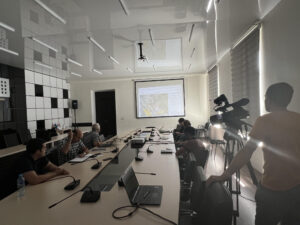 On August 18, the civil movement “Gavigudet” attended the Public Deliberation on the Scoping Report of “AMB Alloys” LLC, held in Rustavi City Hall.
Representatives of the company, National Environmental Agency and City Hall attended the meeting.
For the time being, the enterprise works at full capacity and produces ferrosilicomanganese; and is planning to set up a new technological line of 75% ferrosilicon (Fesi).
In addition to arranging new technological line, the report also discusses the changes, made in the existing plant:
– Parameters (height and diameter) of the united exhaust pipe of ferroalloys melting furnace have been changed;
– Changed the disposal conditions for the by-product (slag), particularly, warehousing location;
– Slight changes have been made in the gen-plan of the enterprise, namely, mutual deployment of the production areas;
– Usage of transformer oil regeneration/restoration equipment is planned on the territory, which was not provided by the existing environmental decision;
– Improvement of the drainage water management is also considered.
On August 16, the civil movement “Gavigudet” organized a working group meeting in order to discuss and prepare comments/notes on the scoping report of the ferroalloy plant – “AMB Alloys” LLC.
Out of 26 notes/comments, that we submitted to the National Environmental Agency, we are sharing the ones, we emphasized during the public deliberation:
– We would like to know the exact information about the studies, on the basis of which the general information about the wind diffusion was provided in the report. We think, that the EIA report should contain the information about the direction of the prevailing winds in the project area. In addition to this, the EIA report should reflect the information about the number of days (per year) the wind blows from the production area in the direction of the settlement.
– The EIA report should contain the information about the coke and steel bubble supplier companies; and the information about the conditions and material receiving intensity.
– The waste management plan evaluates the slag as “non-hazardous” waste. The EIA report should clarify the reasons, on which basis this status was given to the slag. Besides, the EIA report should provide the information about the slag removing methods.
The issue of warehousing the slag also needs the further explanation – as, according to the scoping report, 15, 000 tons of slag are planned to be placed in the slag pit per year, and the company has already placed 45, 000 tons of slag in the area. Only after one and a half year of functioning, the amount of slag accumulated on the slag pit is much more than annually planned amount.
– The EIA report should provide detailed information about the companies, responsible for the waste management.
– The EIA report should contain the information about installing the continuous instrumental self-monitoring system; including emission sources, components, subjected to self-monitoring, method, tool and standard, selected for self-monitoring.
– Together with the information about the dust emissions during loading of raw materials in the open furnaces the EIA report should provide the mitigation means for this process.
– It is mentioned in the technological alternatives – „despite the fact, that CO, produced during the melting process in the open or semi-closed furnaces, transforms into CO2 in contact with the air, the main advantage of this type of furnace is that, no accumulation of hazardous gases takes place and the risks of explosion are much lower.” Here the issue to be clarified is – functioning of which furnace (open or semi-closed), more CO2 is released. On top of that, is there any opportunity from the company to ensure proper safety norms by installing closed type of furnace?
– The EIA report should include the information on the percentage of efficiency of cyclone and dry-cleaning equipment.
– According to the scoping report – “management of unorganized emissions depend not only on the quality of construction materials and the peculiarities of the technological process, but also on the simple means, defined by the technical regulation.” What does ‘simple means’ refer in this note? Is it about filters or any other means for controlling unorganized emissions are also considered?
Our movement also asked from the National Environmental Agency to send all our comments to the company as well, in order to properly be taken into consideration in future administrative proceedings.
In addition to this, we would like to receive the decisions, issued on a specific activity.
The informational material was prepared with the financial support of “European Endowment for Democracy” in the framework of the project “Defending Our Right to Clean Air”