
“Gavigudet” Attended the Public Deliberation of the EIA Report of “Ferro Alloys Production” LLC
“Gavigudet” Attended the Public Deliberation of the EIA Report of “Ferro Alloys Production” LLC
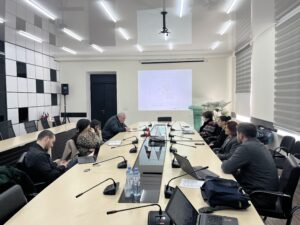 Today, on February 21, public deliberation of the EIA report of “Ferro Alloy Production” LLC on the installation and operation of induction furnaces was held inRustavi City Hall. For your information, because of the flawed documentation, the National Environmental Agency has stopped the administrative procedure several times before now, for issuing an environmental decision on the project.
The deliberation was attended by representatives of the company, National Environmental Agency, Rustavi City Hall, City Council and non-governmental organization – “Green Alternative”, in addition to the civil movement – “Gavigudet”.
As usual, our team provided information about the deliberation of the EIA report to the public in advance (see post).
“Ferro Alloy Production” LLC is planning to install 2 induction furnaces, in which 7200 tons of alloy will be produced annually for 3600 hours. These furnaces will work in alternating mode – when one of the furnaces is functioning, the other furnace is undergoing major repairs.
The enterprise uses only iron scrap as a raw material. Steel alloys are the product.
After reading the EIA report, our team made notes and remarks. After sounding our comments at the deliberation, we sent them to the National Environmental Agency.
We now present to you our comments regarding the report:
– The EIA document does not provide complete information about nearby objects and their functional load, indicating the relevant distances. For example, JSC “Mshenmeqaniaztsia”, which is 250 meters away, is not mentioned at all; LLC “Kano” – 160 meters away; JSC “Komplekti” – located 320 meters away; LLC “Chiora” – 200 meters away; “Sando” LLC – 230 meters away; JSC “Sarin” – 460 meters; “Georgian Birch Company” LLC – 450 meters away; “Georgian International Service” LLC – 410 meters away.
– According to the presented documentation, two furnaces are not expected to operate together in the enterprise. The furnaces will be replaced only when one of them fails. According to the information given in the document, the guarantee of this is the number of products released annually. How is the National Environment Agency going to control this? Will the appropriate agency be in touch with the Revenue Service to obtain information on the quantity of products produced to determine, how conscientiously a particular enterprise is operating?
– In chapter 3.1 of the EIA report – “Technological Scheme and Regulations” – it is mentioned that “the building to be built on the territory will be a shed-type building, which will be roofed only from the top, and will be open from the sides, the area of the mentioned building will be 150 m2, with dimensions of 25×60 m”. However, it is not clear what specific purpose this building will have, storing raw materials, storing finished products, or some other purpose? As the representative of the company explained at the deliberation, the building will be used for installing stoves and will be closed from the sides. It would be better, if this issue was mentioned in the EIA report.
– It is preferable, that the area, that is planned to be used for safe storage of explosive objects (cylinders of various purposes, closed and oiled objects, shock absorbers, jacks) found in scrap metal, be indicated on the general plan.
– It is clear from the EIA report, that laboratory studies of slag will be conducted directly before their sale. Based on the fact that slag management issues are acute in Rustavi, we ask the National Environmental Agency to reflect in the environmental decision the company’s periodic submission of documents confirming laboratory studies and sale of slag;
– Chapter 4.11 of the EIA – “Generation of waste and impacts in the process of its management, conditions of waste management” – it is mentioned, that “dust containing metal caught in the dust collection system will be temporarily stored and then transferred to the entities with the right of agglomeration”. It is preferable, for the document to describe the conditions of temporary storage of this dust (will the dust be stored in hermetically sealed conditions, protected from atmospheric precipitation and wind?).
– In the EIA report, the importance of waste management is assessed as “medium”. This record is unclear, given that the management of slag as a waste is a major challenge for most enterprises;
– It is also interesting, what is the situation regarding the installation of the self-monitoring system? When will the enterprise join the electronic system?
As the director of the enterprise stated at the deliberation, this particular activity does not require the installation of a self-monitoring system, since the production does not have a large amount of emissions. It is preferable, for us to have a confirmed answer/document from the Ministry indicating whether or not the mentioned production is subject to emission measurement by self-monitoring method.
– At the deliberation, the representative of the company announced that he plans to equip the dust collection system with sleeve filters; However, the EIA report states that the dust collection system will be equipped only with the so-called cyclone. Accordingly, this part of the EIA report needs to be clarified so that the information presented in the document and the information presented at the discussion correspond to each other.
– The zero alternative presented in the EIA report is not properly justified in the environmental direction. The main focus of the consideration of alternatives is economic benefit, while a large part should be devoted to why the particular activity is better for the environment and the local residents in the particular selected area.
– In the EIA report, the impact on atmospheric air is considered “medium”. While in the report on the dispersion of harmful substances (EIA Chapter 4.1.1) it is revealed that the indicators of inorganic dust (0.72) and nitrogen dioxide (0.61) emission are quite high near the settlement.
– If there are any comments, it is preferable to send the letters sent by us to the Ministry electronically to the company as well, so that the errors don’t occur again. If the documentation is flawed and the letter includes our comments, it is recommended that this letter be sent electronically to the following e-mail address: gavigudet@gmail.com . In case of disregarding the notes, it is preferable, to inform us of the reason for this.
– Coming from the fact, that the civil movement “Gavigudet” actively follows the ongoing administrative proceedings in the Ministry, regarding the existing/planned activities of enterprises in Rustavi, attends public deliberations and sends comments, it is preferable, that the relevant decision or conclusion issued on a specific activity, be sent to us as well.
The informational material is prepared by “Eco Centre” in the framework of USAID Civil Society Engagement Program, funded by United States Agency for International Development (USAID).
The contents of this material are the sole responsibility of the “Eco Centre” and do not necessarily reflect the views of USAID, the United States Government, or EWMI.